
 457*
457*By clicking on You, Agreed to our Privacy Policy & Terms of use *Disclaimer
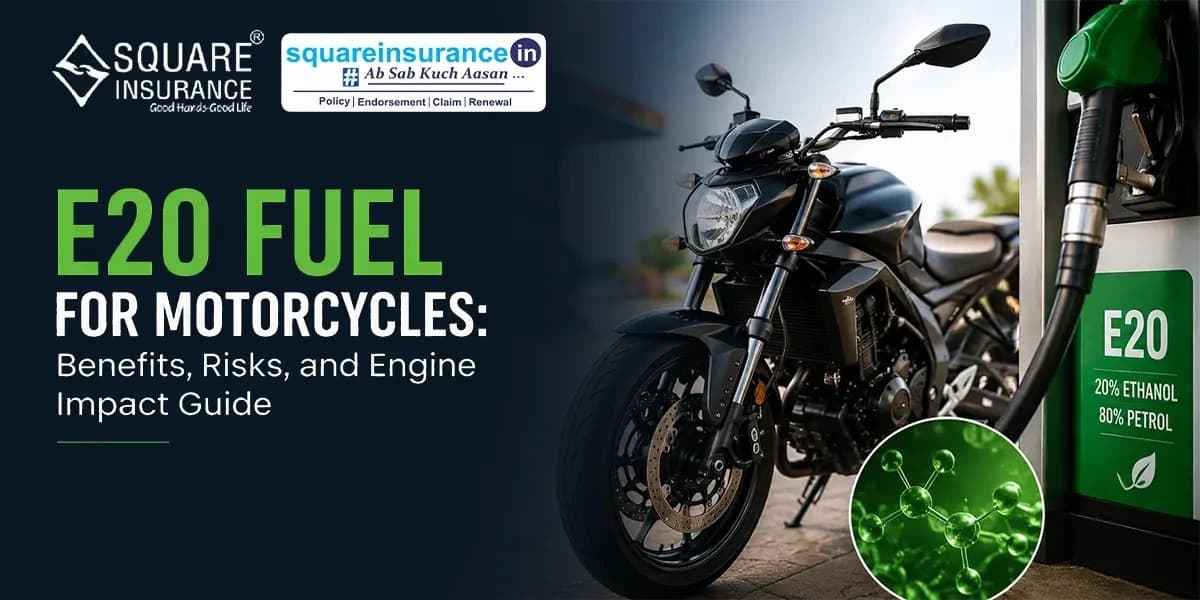
As India works to reduce vehicle emissions, the Indian government introduced a sustainable fuel option for all petrol vehicles. Known as E20, it became compulsory to be available at every petrol pump from 1st April 2026. This is actually an important step towards cleaner transportation.
If you own a motorcycle, then you must be aware of the term E20. But just knowing the term will not make your driving experience simpler and understand E20 fuel benefits.
This blog will help you to understand its effect on your bike's performance, mileage, engine, and maintenance.
What is E20 Petrol for Motorcycle?
E20 fuel is a blend of 20% ethanol and 80% petrol. Here, "E" stands for Ethanol, a renewable fuel made from crops like sugarcane and maize, while "20" refers to the 20% ethanol content in the fuel.
The Government of India introduced E20 fuel to reduce pollution and decrease dependence on imported crude oil. It was first launched at selected fuel stations on 6 February 2023 and became the standard petrol supplied across India from 1 April 2026.
Before using E20 fuel, owners of older motorcycles should check whether their bike is E20 compatible or not.
How Does E20 Fuel Work in a Motorcycle Engine?
The working process is as follows:
- 1.Fuel Injection: E20 fuel is supplied from the fuel tank to the engine through the fuel injection system or carburettor.
- 2.Air-Fuel Mixing: The fuel mixes with air in the correct ratio inside the combustion chamber.
- 3.Ignition: The spark plug ignites the air-fuel mixture, generating energy to move the piston.
- 4.Power Generation: The piston transfers this energy to the crankshaft, which powers the motorcycle.
- 5.Cleaner Exhaust: Since ethanol contains oxygen, the fuel burns more completely, resulting in fewer harmful exhaust emissions.
Which Motorcycles are Compatible with E20 Fuel for Bikes in India?
Almost all motorcycles manufactured since April 2023 are E20-compatible. These bikes are equipped with ethanol-resistant fuel system components and updated fuel-injection engines that safely run on petrol blended with up to 20% ethanol (E20).
Most major two-wheeler manufacturers in India now offer E20-compliant motorcycles, including:
- Hero MotoCorp
- Honda
- TVS
- Bajaj
- Yamaha
- Suzuki
- Royal Enfield
- KTM
Note: The above list includes only some popular E20-compatible motorcycles. Most bikes manufactured after April 2023 are E20-ready, but compatibility varies by model and variant. Check your owner's manual or confirm with the manufacturer before using E20 fuel.
Benefits of Using E20 Fuel in Motorcycles
Here are some of the benefits of using E20 fuel E20 fuel for bikes in India:
- Reduces Harmful Emissions: The oxygen present in ethanol burns the fuel completely. It reduces emissions of carbon monoxide (CO) and unburnt hydrocarbons (HC).
- Lowers Carbon Footprint: Ethanol is produced from renewable crops like sugarcane and maize, which limit overall greenhouse gas emissions.
- Reduces Crude Oil Imports: Since E20 contains 20% ethanol, it lowers India's dependence on imported crude oil and improves the country's energy security.
- Supports Indian Farmers: Higher ethanol production increases the demand for crops such as sugarcane and maize. This creates additional income opportunities for farmers.
- Better Combustion: The oxygen content in ethanol promotes cleaner and more efficient combustion.
- Promotes Cleaner Transportation: By replacing a portion of fossil fuel with renewable ethanol, E20 supports India's transition toward cleaner and more sustainable mobility.
Risks of Using E20 Fuel in Motorcycles
E20 petrol is designed for E20-compatible motorcycles. If your bike is not built for E20, using it regularly can cause a few problems over time. Here's what you should know:
Slightly Lower Mileage
Ethanol contains less energy than petrol. Because of this, your motorcycle can travel fewer kilometres per litre compared to regular petrol.
Damage to Fuel Pipes and Seals
Older motorcycles use rubber and plastic parts in the fuel system that are not designed for higher ethanol content. Over time, E20 can wear out these parts, which leads to fuel leaks or costly repairs.
Fuel Can Absorb Water
Ethanol naturally attracts moisture from the air. If the motorcycle is left unused for weeks or months, water can mix with the fuel. This makes it less effective and can cause performance issues.
Starting Problems in Cold Weather
Since ethanol evaporates more slowly than petrol in low temperatures, some motorcycles can take longer to start on cold mornings.
Reduced Engine Performance
The engine in an incompatible bike is not tuned for a higher ethanol blend. Using E20 for such bikes can lead to rough engine operation, reduced pickup, engine knocking, or power loss.
More Maintenance Over Time
If incompatible motorcycles are regularly filled with E20, maintenance and repair costs will increase over time.
Impact of E20 Fuel on Motorcycle Engine
E20 fuel affects a motorcycle engine differently depending on whether the bike is E20-compatible.
- For E20-compatible motorcycles: The engine runs normally, with cleaner combustion and no major impact on performance.
- For non-E20-compatible motorcycles: Regular use can reduce mileage, affect engine performance, and cause wear to fuel system components such as rubber hoses, seals, and gaskets over time.
Does E20 Fuel Reduce Bike Mileage?
Yes, E20 fuel can slightly reduce a motorcycle's mileage.As per the NITI Aayog and Ministry of Petroleum & Natural Gas's Roadmap for Ethanol Blending in India (2020 - 25), non-E20-compatible motorcycles designed for E0 and calibrated for E10 can experience a fuel efficiency loss of around 3 to 4% when running on E20 petrol.
This is because ethanol contains less energy than petrol, so the engine needs to burn a little more fuel to produce the same amount of power.
For E20-compatible motorcycles, the reduction in fuel efficiency is usually small and unnoticeable.
Tips for Using E20 Petrol Safely in a Motorcycle
Here are some of the tips for using E20 petrol safely:
- Check if your vehicle is E20-compatible before using E20 petrol.
- Follow the fuel recommended by the manufacturer.
- Refuel only at authorised petrol pumps.
- Get your vehicle serviced regularly.
- Watch for changes in mileage or engine performance.
- Visit an authorised service centre if you notice any issues.
However, if your motorcycle is E20-compatible, using E20 petrol does not affect your insurance coverage. Claims for accidental damage or other covered events will continue to be settled according to your policy terms.
Conclusion
To conclude, E20 fuel is a step towards cleaner and more sustainable transportation. While it offers benefits such as lower emissions, reduced dependence on crude oil, and support for renewable energy, its suitability depends on your motorcycle.
If your bike is E20-compatible, you can use it without concerns. However, owners of older motorcycles should first check the manufacturer's recommendation to avoid engine or fuel system issues.
Understanding your bike's compatibility will help you enjoy the benefits of E20 while maintaining its performance and longevity.
FAQs
E20 petrol is a fuel that contains 20% ethanol and 80% petrol. It is introduced to reduce vehicle emissions, lower crude oil imports, and promote the use of renewable fuel.
E20 fuel for bikes in India is safe if the motorcycle is E20-compatible. If your bike is an older model, check the owner's manual or confirm with the manufacturer before using E20 petrol.
Use E20 fuel only if your motorcycle manufacturer has approved it. Older bikes that are not E20-compatible can face engine or fuel system issues.
In an E20-compatible motorcycle, performance remains normal. In older bikes, it can reduce mileage and affect engine performance over time.
You can check your owner's manual or contact the motorcycle manufacturer or an authorised service centre.
Yes, E20 petrol is available at petrol pumps across India as part of the government's nationwide rollout.
No, E20-compatible motorcycles do not need any modifications. Older motorcycles should follow the manufacturer's fuel recommendation.
 457*
457*By clicking on You, Agreed to our Privacy Policy & Terms of use *Disclaimer
- 5.5 CrRegistered Consumers
- 50+Insurance Partners
- 3.4 CrPolicies Sold


