
 2094*
2094*By clicking on You, Agreed to our Privacy Policy & Terms of use *Disclaimer
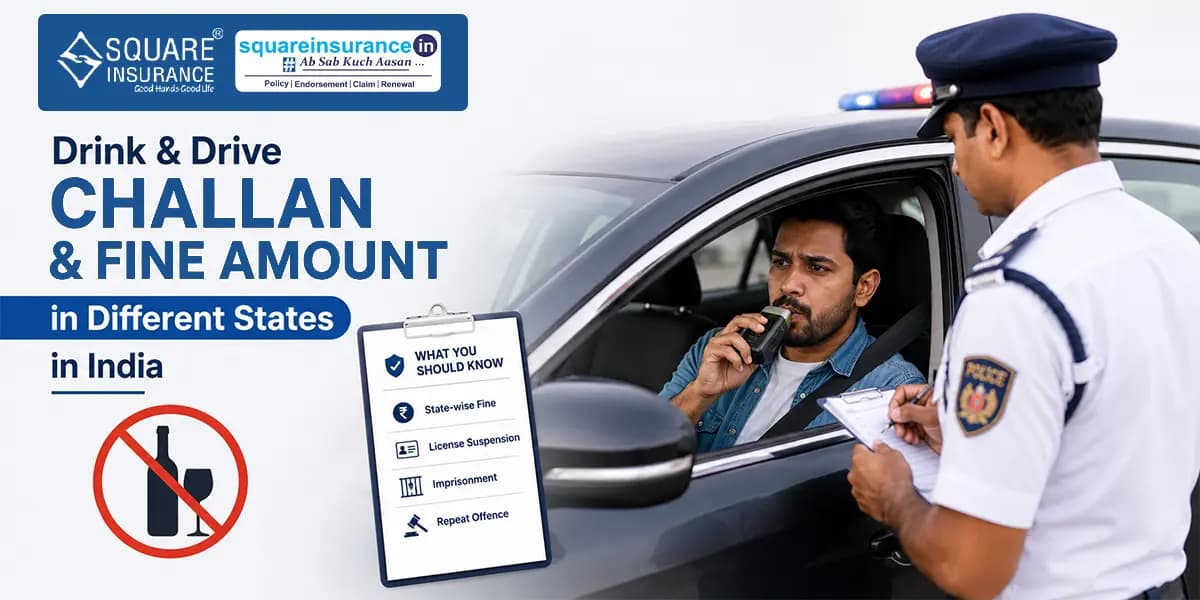
Driving after drinking can put the driver, passengers, and other road users at risk. Indian traffic law treats drunk driving as a serious offence, with penalties that can include a fine and imprisonment.
The rules are mainly governed by Section 185 of the Motor Vehicles Act. The law sets a common base penalty, but the way a case is handled can differ across states. This makes it important to understand both the drink and drive challan amount and the possible consequences of the offence.
What Is the Drink and Drive Fine Amount in India?
Section 185 applies when a person drives or attempts to drive a motor vehicle while under the influence of alcohol or drugs. For alcohol, the prescribed limit is more than 30 mg of alcohol per 100 ml of blood.
The base penalties are:
| Offence | Base Fine | Maximum Imprisonment |
|---|---|---|
| First offence | Up to Rs 10,000 | Up to 6 months |
| Repeat offence within 3 years | Up to Rs 15,000 | Up to 2 years |
The punishment can involve a fine, imprisonment, or both, depending on the circumstances and applicable legal process.
What Is the Drink and Drive Challan Amount in Different States?
The base monetary penalty under Section 185 is prescribed by central law. Therefore, the basic fine does not become a different amount simply because the offence takes place in another state.
However, the process after being caught can differ depending on the state, local enforcement practices, and court proceedings.
What Is the Alcohol Limit for Drink and Drive?
Under Section 185, the relevant limit is more than 30 mg of alcohol per 100 ml of blood.
In simple terms, crossing this prescribed limit while driving can result in action under the drunk-driving provisions.
Authorities can use a breath analyser as part of the detection process. Further testing can also be carried out where required under the applicable procedure.
What Happens If You Are Caught Driving Drunk?
A person caught driving under the influence can face more than just a challan.
Depending on the circumstances, the case can involve:
- Monetary penalty
- Imprisonment
- Driving licence action
- Court proceedings
- Vehicle impoundment
- Towing and storage charges
- Other local enforcement measures
Drink driving is treated as a serious offence. In many cases, the matter can require appearance before a local magistrate's court rather than being handled like a routine online traffic challan.
Can Your Driving Licence Be Suspended?
Licence-related action can also form part of the consequences of a drink-and-drive offence.
The exact action depends on the applicable law, court order and enforcement process. The information provided for this article mentions a 3-month suspension for a first offence and permanent disqualification or cancellation for a repeat offence.
Because licence action can depend on the circumstances of the case, drivers should check the order or directions issued in their specific matter.
Can Your Vehicle Be Impounded?
Yes, vehicle impoundment can occur during enforcement in some circumstances.
If traffic authorities take the vehicle into custody, the owner may also have to deal with towing and storage charges.
The exact process and charges can vary by local authority.
Is the Drink and Drive Fine the Same in Every State?
The base fine under Section 185 is based on central law. However, the overall process can differ between states.
For example, states can have different approaches to:
- Court proceedings
- Licence action
- Vehicle impoundment
- Counselling requirements
- Local enforcement procedures
- Towing or storage arrangements
Can You Pay a Drink and Drive Challan Online?
Drink-and-drive cases are not always handled like ordinary traffic challans.
Because Section 185 involves a criminal offence, the matter can require court proceedings. The exact method of settlement depends on the case and applicable local procedure.
Therefore, if you receive a drink-and-drive challan, check the instructions provided by the traffic authorities or court instead of assuming that it can simply be paid through the standard e-challan process.
You can check and pay challans for Andaman and Nicobar Islands, Arunachal Pradesh, Assam, Bihar, Chandigarh, Chhattisgarh, Dadra and Nagar Haveli and Daman and Diu, Goa, Himachal Pradesh, Haryana, Jharkhand, Jammu and Kashmir, Karnataka, Ladakh, Maharashtra, Meghalaya, Manipur, Mizoram, Nagaland, Punjab, Puducherry, Sikkim, Tamil Nadu, Uttarakhand, West Bengal, Rajasthan and Gujarat on the NextGen eChallan Portal.
What Happens If You Repeat the Offence?
The consequences become more serious when the offence is repeated within the specified period.
For a repeat offence within three years, the penalty can include:
- Fine of up to Rs 15,000
- Imprisonment of up to 2 years
- Licence-related action
- Other applicable court or enforcement measures
This is significantly higher than the first-offence penalty of up to Rs 10,000.
Why Is Drink and Drive Punished Strictly?
Driving under the influence can affect a person's ability to control the vehicle safely.
Alcohol can affect:
- Reaction time
- Judgement
- Concentration
- Coordination
- Ability to respond to traffic conditions
The legal restrictions are therefore aimed at preventing accidents before they happen.
A drink-and-drive offence can also create financial and legal problems for the driver, apart from the risk posed to other people on the road.
Conclusion
The drink-and-drive challan and fine amount in India is primarily governed by Section 185 of the Motor Vehicles Act. The base penalty can be up to Rs 10,000 and/or six months' imprisonment for a first offence. A repeat offence within three years can attract a fine of up to Rs 15,000 and/or imprisonment of up to two years.
The monetary penalty is based on central law, but the process for handling the offence can differ across states. Court proceedings, licence action and vehicle-related measures can also apply.
The safest approach is not to drive after consuming alcohol. The cost of a drink-and-drive offence can go far beyond the challan amount.
Also Read - How to Pay e-Challan OnlineFAQs
What is the fine for drunk driving in India?
For a first offence, the fine can be up to Rs 10,000, along with possible imprisonment of up to six months.
What is the penalty for a second drink-and-drive offence?
A repeat offence within three years can attract a fine of up to Rs 15,000 and imprisonment of up to two years.
What is the legal alcohol limit for driving in India?
The prescribed limit under Section 185 is more than 30 mg of alcohol per 100 ml of blood.
Is the drink-and-drive fine the same in every state?
The base fine is prescribed under central law. However, the enforcement process and additional administrative measures can differ between states.
Can a vehicle be seized for drunk driving?
Vehicle impoundment can occur depending on the circumstances and local enforcement procedure. Towing and storage charges can also apply.
Can a drink-and-drive case require a court appearance?
Yes. Since drunk driving is treated as a serious offence under Section 185, the case can require proceedings before a local magistrate's court.
How is drunk driving detected?
A breath analyser is commonly used to detect alcohol levels. Further testing can be carried out where required under the applicable procedure.
For a first offence, the fine can be up to Rs 10,000, along with possible imprisonment of up to six months.
A repeat offence within three years can attract a fine of up to Rs 15,000 and imprisonment of up to two years.
The prescribed limit under Section 185 is more than 30 mg of alcohol per 100 ml of blood.
The base fine is prescribed under central law. However, the enforcement process and additional administrative measures can differ between states.
Vehicle impoundment can occur depending on the circumstances and local enforcement procedure. Towing and storage charges can also apply.
Yes. Since drunk driving is treated as a serious offence under Section 185, the case can require proceedings before a local magistrate's court.
A breath analyser is commonly used to detect alcohol levels. Further testing can be carried out where required under the applicable procedure.
 2094*
2094*By clicking on You, Agreed to our Privacy Policy & Terms of use *Disclaimer
- 5.5 CrRegistered Consumers
- 50+Insurance Partners
- 3.4 CrPolicies Sold


