
 2094*
2094*By clicking on You, Agreed to our Privacy Policy & Terms of use *Disclaimer
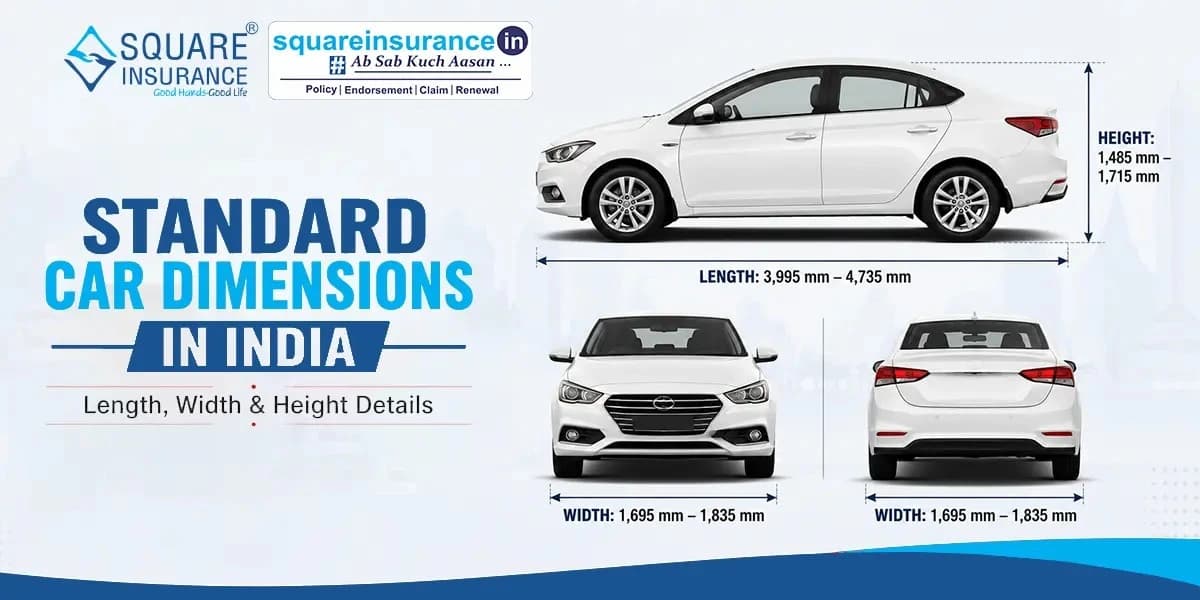
There are multiple details we want to know when buying cars. While mileage, features, price, and safety ratings are often the top priorities, car dimensions also play an important role.
The length, width, and height of a car affect how easily it can be driven through city traffic and parked in tight spaces.
Whether you are planning to buy a hatchback, sedan, or SUV, it is important to understand standard car dimensions. This can help you to compare models and choose one that best suits your needs. In this article, we will explain the standard car dimensions in India.
What Are Car Dimensions?
Car dimensions refer to the length, width, and height of a vehicle. These measurements tell you about the space occupancy of your car. They also help you to understand whether the car will be easy to drive on roads, park in small spaces, and provide enough room for passengers inside.
There is no single standard size for all cars in India because dimensions vary depending on the vehicle segment. For example, a hatchback is usually smaller than an SUV.
- Manufacturer's website
- Brochure
- Dealer
- Automotive websites
- Owner's manual
Car Dimensions by Vehicle Segment in India
Car dimensions vary depending on the type of vehicle. Hatchbacks are generally the smallest, while SUVs and MPVs are larger and offer more interior space. The table below shows the average dimensions of different car segments sold in India.
| Vehicle Segment | Typical Length | Typical Width | Typical Height |
|---|---|---|---|
| Hatchback | 3.4 - 4.0 m | 1.5 - 1.8 m | 1.45 - 1.55 m |
| Sedan | 4.0 - 4.6 m | 1.7 - 1.8 m | 1.45 - 1.50 m |
| Compact SUV | 4.0 - 4.4 m | 1.75 - 1.85 m | 1.60 - 1.70 m |
| Mid-size SUV | 4.4 - 4.9 m | 1.80 - 1.95 m | 1.65 - 1.85 m |
| MPV | 4.0 - 5.2 m | 1.70 - 2.00 m | 1.70 - 1.90 m |
Note: These are approximate ranges based on popular passenger vehicles sold in India. The actual dimensions can vary from one model to another.
Understanding Each Car's Dimension
Here's what each dimension means and how it affects your driving experience.
Car Length
Car length is the distance from the front bumper to the rear bumper.
How it affects your car:- A longer car usually offers more legroom and a larger boot.
- It provides better comfort for long-distance travel.
- However, it can be harder to park and drive through narrow city roads.
- A shorter car is easier to park and is more suitable for daily city driving.
Car Width
Car width is the distance from one side of the car to the other, excluding the side mirrors (unless mentioned otherwise).
How it affects your car:- A wider car provides more shoulder room for passengers.
- It makes the cabin feel more spacious.
- It also improves stability while taking turns at higher speeds.
- However, it may be slightly difficult to drive through narrow lanes or fit into tight parking spaces.
Car Height
Car height is measured from the ground to the highest point of the roof.
How it affects your car:- A taller car provides more headroom for passengers.
- It offers a higher driving position, improving road visibility.
- SUVs and MPVs are taller, making it easier to get in and out.
- However, taller vehicles can experience slightly more body roll while cornering compared to lower cars.
Wheelbase
The wheelbase is the distance between the centres of the front and rear wheels.
How it affects your car:- A longer wheelbase usually improves ride comfort.
- It provides more legroom for passengers.
- It also makes the car more stable at highway speeds.
- A shorter wheelbase allows the car to turn more easily in tight spaces.
Ground Clearance
Ground clearance is the distance between the lowest part of the car and the road surface.
How it affects your car:- Higher ground clearance helps the car pass over speed breakers and rough roads without scraping the underside.
- It is useful on uneven roads and during the rainy season.
- Lower ground clearance generally improves handling and stability on smooth roads, but requires more care on bad roads.
Why Car Dimensions Matter Before Buying
Car dimensions are important for the following reasons:
- Easy Parking: A smaller car is easier to park in tight spaces, while a larger car needs more parking room.
- Driving Comfort: Compact cars are easier to drive through city traffic, whereas larger cars are better suited for highways and long journeys.
- Cabin and Boot Space: Longer and wider cars usually offer more legroom, shoulder room, and luggage space.
- Road Conditions: Cars with higher ground clearance can handle speed breakers, potholes, and uneven roads more comfortably.
- Family Size: If you often travel with family or carry luggage, choosing a car with larger dimensions can provide better comfort.
- Garage Space: Before buying a car, make sure it fits comfortably in your home or office parking area.
How to Measure Car Dimensions
Car dimensions are usually mentioned in the manufacturer's specifications. However, if you want to measure them yourself, follow these simple steps:
1Length
Measure the distance from the front bumper to the rear bumper. This gives you the total length of the car.
2Width
Start by measuring the distance from one side of the car to the other. Unless specified, the width is measured without the side mirrors.
3Height
Measure from the ground to the highest point of the car, which is usually the roof. If the car has roof rails or an antenna, check whether they are included in the manufacturer's specifications.
4Wheelbase
Measure the distance between the centre of the front wheel and the centre of the rear wheel on the same side.
5Ground Clearance
Measure the distance between the ground and the lowest fixed part of the car, excluding the tyres.
Tip: For the most accurate measurements, park the car on a flat and level surface before measuring.
Comparison of Popular Cars Based on Dimensions
The table below compares the dimensions of some of the most popular cars in India:
| Car Model | Segment | Length | Width | Height |
|---|---|---|---|---|
| Maruti Suzuki Swift | Hatchback | 3,860 mm | 1,735 mm | 1,520 mm |
| Maruti Suzuki Baleno | Premium Hatchback | 3,990 mm | 1,745 mm | 1,500 mm |
| Maruti Suzuki Dzire | Sedan | 3,995 mm | 1,735 mm | 1,525 mm |
| Tata Punch | Micro SUV | 3,827 mm | 1,742 mm | 1,615 mm |
| Maruti Suzuki Brezza | Compact SUV | 3,995 mm | 1,790 mm | 1,685 mm |
| Hyundai Creta | Mid-size SUV | 4,330 mm | 1,790 mm | 1,635 mm |
| Tata Harrier | Mid-size SUV | 4,605 mm | 1,922 mm | 1,718 mm |
| Toyota Innova Hycross | MPV | 4,755 mm | 1,850 mm | 1,790 mm |
Note: The dimensions shown are for the latest available models. They can vary slightly depending on the variant and model year.
Conclusion
To conclude, the standard car dimensions can vary from car to car. The length, width, and height depend on the type and size of the vehicle. These measurements help you understand how much space the car offers and how easy it will be to drive and park.
Before buying a car, compare its dimensions along with its features and price. Choosing the right car size can make your everyday driving more comfortable and practical.
FAQs
Car dimensions in feet vary depending on the vehicle type. Most passenger cars in India are around 11–16 feet long, 5–6 feet wide, and 4.5–6 feet tall.
Car dimensions in meters are usually measured by length, width, and height. Most cars in India are about 3.5–5 meters long, 1.5–2 meters wide, and 1.4–1.9 meters high.
Standard car dimensions in India depend on the vehicle segment. In general, most passenger cars are between:
- 3.5-5 meters in length
- 1.5-2 meters in width
- 1.4-1.9 meters in height
Car length affects parking, boot space, and passenger comfort. Longer cars usually offer more interior space, while shorter cars are easier to drive and park in cities.
In most cases, the width mentioned in a car's specifications does not include the side mirrors. However, some manufacturers may also provide the overall width with mirrors.
A hatchback or compact SUV is generally the best choice for city driving. These cars are easier to handle in traffic and fit into smaller parking spaces.
 2094*
2094*By clicking on You, Agreed to our Privacy Policy & Terms of use *Disclaimer
- 5.5 CrRegistered Consumers
- 50+Insurance Partners
- 3.4 CrPolicies Sold


