
 2094*
2094*By clicking on You, Agreed to our Privacy Policy & Terms of use *Disclaimer
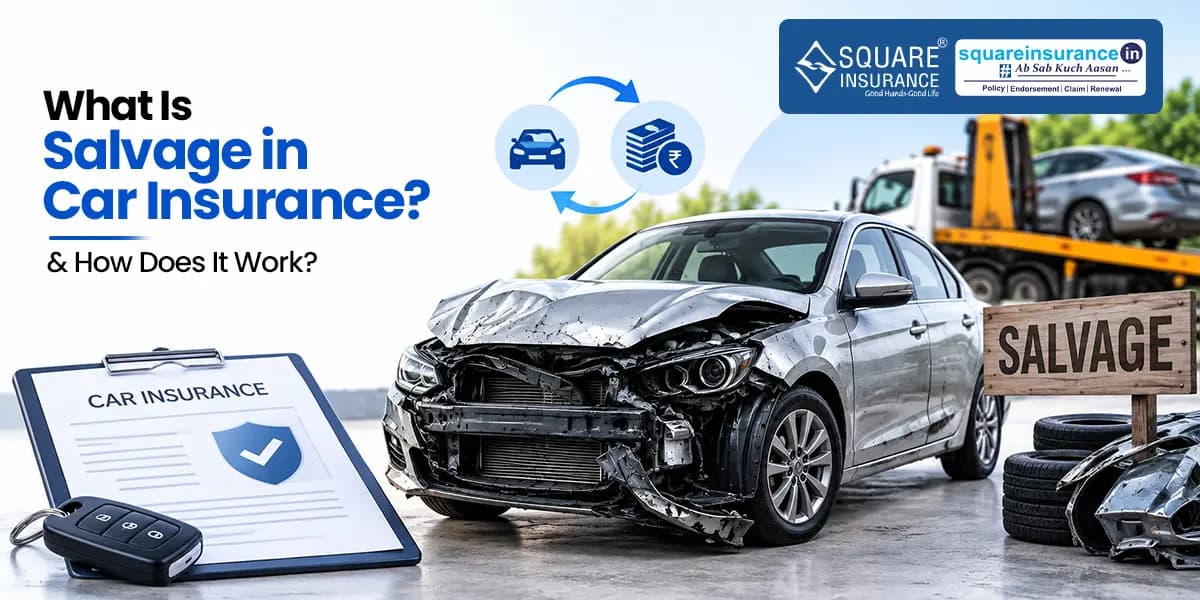
- Salvage refers to the damaged vehicle or wreck that still has some recoverable value after a total-loss claim.
- The salvage value depends on factors such as the car's condition, age, damage, repair cost, and parts demand.
- A salvage or rebuilt history can affect the car's resale value and future insurance coverage.
Insurance has many terms that can sound confusing at first. Salvage is one of them. In car insurance, salvage refers to the damaged vehicle or wreck that still has some recoverable value after a major loss.
For example, a badly damaged car can still have usable parts or scrap value. The amount these recoverable parts or materials are worth is known as the salvage value.
In this blog, we explain what salvage means, how it works during a car insurance claim, and what happens to a vehicle after it is declared a total loss.
What Is Salvage in Insurance?
In car insurance, salvage refers to the damaged vehicle or wreck that still has some recoverable value after a major loss. Even when a car is treated as a total loss, components such as the engine, metal parts, and other usable parts can still have value. The monetary value of the damaged vehicle, its recoverable parts, or scrap is known as the salvage value.
How Does Salvage Work in Car Insurance?
Salvage usually comes into the picture when repairing a damaged vehicle costs too much compared with its insured value.
Under the 75% rule for a Constructive Total Loss (CTL), a vehicle can be treated as a total loss when the combined cost of retrieval and repairs goes beyond 75% of its IDV. In such situations:
- The insurer takes possession of the damaged vehicle or wreck as salvage and settles the claim according to the applicable policy terms.
- If the policyholder is allowed to retain the damaged vehicle, the estimated salvage value is generally deducted from the claim amount.
Let's understand it with an example
Rajeev gets into a road accident while driving on the highway. At the time of the accident, his car has an IDV of ?8 lakh. The estimated cost of retrieving and repairing the car is more than ?6 lakh, which exceeds 75% of its IDV. Therefore, the vehicle qualifies as a Constructive Total Loss (CTL).
The damaged vehicle is then treated as salvage during the claim settlement process, and its salvage value is assessed according to the applicable policy terms.
How Is Salvage Value Calculated?
There is no single fixed formula for calculating salvage value. It generally depends on the condition of the damaged vehicle, the parts that can be recovered, and what buyers are willing to pay for the vehicle, its parts, or scrap.
1Extent of Damage
The type and severity of the damage also matter. A vehicle with several usable components left in good condition can have more salvage value than one with extensive damage to major parts.
2Repair Cost
Repair expenses are compared with the vehicle's value to determine whether restoring it makes financial sense. When the cost becomes excessive, the insurer may treat the vehicle as a total loss. The salvage value then represents the value that remains in the damaged car.
3Age and Condition
A newer car in good condition can retain more value through its usable components. An older vehicle with high mileage generally has a lower residual value.
4Demand for Parts
The demand for particular vehicle parts can make a difference. Parts for popular models may have a ready market, while rare models can also attract buyers because some replacement parts are harder to find.
5Location
The location can affect the amount as well. Where there is strong demand for used parts or scrap metal, damaged vehicles may attract better salvage offers.
How Can a Salvage Vehicle Be Handled?
The condition of the salvage parts decides their value and possible outcome. Let's understand it in a better way:
| Condition of the vehicle | Possible outcome |
|---|---|
| Vehicle is severely damaged and not economical to repair | It can be dismantled for usable parts or sold as scrap. |
| Vehicle has recoverable parts | Usable components can be removed and sold separately. |
| Vehicle can be repaired and is permitted to return to the road | It can be repaired subject to applicable inspection, registration and other requirements. |
| Vehicle is retained by the policyholder | The policyholder settles the claim according to the applicable terms and bears the cost and responsibility of restoring the vehicle. |
What Happens to a Salvage Vehicle?
After a vehicle is written off, it can be sold through the applicable salvage process. Salvage yards, dismantlers, repair shops, and parts buyers may purchase it.
What happens next depends on the condition of the vehicle. It may be:
- Dismantled so usable parts can be sold
- Sold as scrap
- Repaired and restored, where permitted
If the vehicle is repaired, its salvage or rebuilt history can remain relevant. This can affect how much buyers are willing to pay for it and whether an insurer is willing to cover it.
Should You Sell or Keep a Salvage Vehicle?
Once a vehicle is declared a total loss, the owner may have the option to sell it or retain it, depending on the insurer's settlement terms and applicable rules.
01Selling the Vehicle
Selling the damaged vehicle can be a simpler option when restoring it would be expensive. It can enter the salvage market, where buyers look at its parts, scrap value, and possibility of repair.
A salvage history can bring down the vehicle's resale value because future buyers may be hesitant about its previous damage.
02Keeping the Vehicle
Some owners prefer to retain the vehicle and arrange the repairs themselves. In that case, they have to bear the repair expenses and complete any inspection or certification required before the car can legally return to the road.
Even after the repairs are completed, the vehicle's salvage history can affect its resale value and future insurance options.
Conclusion
Salvage in car insurance is the part that still holds some value after a total loss. It holds the value that remains in a car after major damage. This salvage value depends on several things, including the vehicle's condition, repair costs, age, and demand for its parts.
So, understanding the term will not only help you to calculate your car's value after total loss but also make the claim settlement easier to understand.
FAQs
Salvage value is the amount a damaged vehicle or its recoverable parts can still be worth after a major loss.
No, IDV is the insured value of the car, while salvage value is what the damaged vehicle or its usable parts are still worth.
It generally becomes relevant when a car suffers major damage and is treated as a total loss or Constructive Total Loss.
A vehicle can be considered a Constructive Total Loss when the combined cost of retrieval and repairs exceeds 75% of its IDV.
In some cases, yes. This depends on the insurer's settlement terms and applicable rules. Repairs, inspections, or certification may be required before the vehicle can return to the road.
A salvage or rebuilt history can reduce resale value because buyers may be concerned about the vehicle's previous damage.
It depends on the insurer, the vehicle's condition, and its history. Some insurers may provide coverage with conditions, while others may decline it.
The vehicle can be sold through the applicable salvage process. Depending on its condition, it may be dismantled for parts, sold as scrap, or repaired where permitted.
 2094*
2094*By clicking on You, Agreed to our Privacy Policy & Terms of use *Disclaimer
- 5.5 CrRegistered Consumers
- 50+Insurance Partners
- 3.4 CrPolicies Sold


