
 2094*
By clicking on You, Agreed to our Privacy Policy & Terms of use *Disclaimer
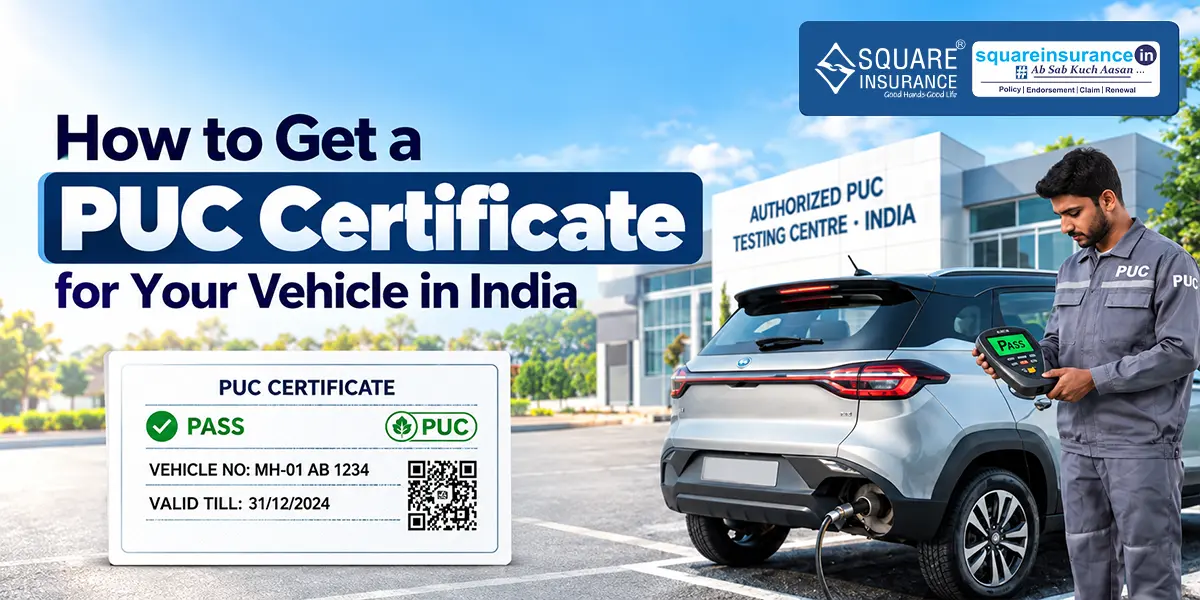
- PUCC, or Pollution Under Control Certificate, confirms that your vehicle meets the prescribed emission limits.
- It is mandatory under the Central Motor Vehicles Rules, 1989, Rule 115 (7).
- You can check and download an existing PUC certificate through the official Parivahan PUC portal.
- PUCC is required for petrol, diesel, LPG, and CNG vehicles. You do not need to have a PUC for EV vehicles.
Air quality is a concern in many Indian cities, and vehicle emissions are one of the sources of air pollution. Regular emission checks help identify vehicles that release pollutants beyond the permitted limits. For this purpose, the Pollution Under Control (PUC) certificate is required under India's motor vehicle rules.
A PUC certificate records the result of your vehicle's emission test. You need to visit an authorised testing centre to get a new certificate or renew an expired one. If you already have a certificate, you can check its details and download a copy online.
In this blog, we will explain how to get a PUC certificate, check its status, understand its validity, and learn about the applicable charges and emission tests.
- What Is a PUC Certificate?
- Why Is a PUC Certificate Mandatory in India?
- How to Get a PUC Certificate Offline
- Steps for PUC Certificate Download Online
- How to Check Status for PUC Certificate Online
- How Is a Vehicle Checked During a PUC Test?
- Different PUC Tests for Different Vehicle Types
- What Are the Permissible Emission Limits for PUC Testing?
- How to Find an RTO-Authorised PUC Testing Centre
- PUC Certificate Validity: When Should You Renew It?
- PUC Certificate Charges
- Conclusion
- FAQs
What Is a PUC Certificate?
A Pollution Under Control (PUC) certificate is an official document issued by authorised testing centres. It records whether a vehicle meets the applicable exhaust emission standards at the time of testing in order to control air pollution.
The certificate generally contains details such as the vehicle registration number, test results, issue date, and validity period.
Under Rule 115(7) of the Central Motor Vehicles Rules, 1989, vehicles must comply with the applicable emission standards. Battery-operated electric vehicles are exempt from the routine PUC requirement because they do not produce exhaust emissions from an onboard combustion engine.
Why Is a PUC Certificate Mandatory in India?
Here is why you should keep your PUC certificate handy while being on the road:
- Legal compliance: The requirement is governed by the Central Motor Vehicles Rules, 1989, particularly Rule 115(7), along with the applicable provisions of the Motor Vehicles Act, 1988.
- Emission monitoring: Regular testing helps identify vehicles that release pollutants beyond the permitted limits.
- Timely repairs: A failed test can alert you to an emission-related problem that needs attention.
- Avoiding penalties: Driving without a valid certificate can result in a traffic challan under the applicable rules.
How to Get a PUC Certificate Offline
You cannot complete the physical emission test entirely online. To get a new PUC certificate or renew an expired one, take your vehicle to an authorised PUC testing centre.
Follow these steps:
- 1.Visit an approved pollution testing centre or a petrol pump that provides PUC testing.
- 2.The operator will identify the vehicle and carry out an emission test.
- 3.The centre records the readings and the required vehicle details.
- 4.Pay the required fee.
- 5.The operator will generate the PUC certificate.
If your vehicle fails the test, get the emission-related issue checked and corrected before arranging another test.
Steps for PUC Certificate Download Online
If your vehicle already has a PUC certificate, you can use the official Parivahan portal to access its details and download a copy where the service is available.
Follow these steps to download your PUC certificate:
- 1.Visit the official Parivahan PUC portal .
- 2.Select the PUC Certificate option.
- 3.Enter your vehicle registration number.
- 4.Enter the last five characters of your chassis number.
- 5.Fill in the displayed captcha code.
- 6.Click PUC Details to retrieve the available information.
- 7.View the certificate and use the available print or download option to save a copy.
Keep a digital copy on your phone so you can access it when required. You can also check whether the certificate is still valid before taking your vehicle on the road.
Remember: The online portal is used to access an existing certificate. It does not replace the physical emission test required for a new certificate or renewal.
How to Check Status for PUC Certificate Online
Here are the steps to check your PUC certificate status:
- You can check your PUC certificate status through the Parivahan PUC portal.
- Then go to the PUC Certificate option.
- Enter the vehicle registration number and chassis number.
- Enter the CAPTCHA.
- Then click on PUC details.
- Then, click on “View Application Details”.
You can easily view your active status, certificate number, issue date, and expiry date. Also, you can easily download a PDF copy of your certificate.
How Is a Vehicle Checked During a PUC Test?
The testing method depends on the vehicle's fuel type and the applicable emission standards. The process generally involves:
- Identifying the vehicle and recording the required details.
- Using an appropriate probe or testing instrument.
- Measuring the pollutants or smoke emissions specified for the vehicle.
- Checking whether the readings meet the applicable limits.
- Recording the result and issuing a certificate if the vehicle passes.
Different PUC Tests for Different Vehicle Types
Petrol, diesel, CNG, and LPG vehicles do not all undergo the same emissions measurement. The equipment and procedure depend on the fuel type and the applicable testing rules.
| Vehicle type | What is checked? | How the test generally works |
|---|---|---|
| Petrol | Carbon monoxide (CO) and hydrocarbons (HC) | An exhaust probe measures the relevant emissions under the prescribed test conditions. |
| Diesel | Smoke density or opacity | A suitable smoke meter measures the exhaust smoke produced during the prescribed test. |
| CNG | Applicable CO and HC emissions | Testing equipment measures exhaust emissions against the relevant limits. |
| LPG | Applicable CO and HC emissions | The vehicle undergoes the prescribed emissions test for its category and fuel type. |
What Are the Permissible Emission Limits for PUC Testing?
The permissible limits depend on the vehicle's fuel type, category, manufacturing date, and applicable emission standard. The limits used in routine PUC testing are also different from the type-approval limits used to certify new vehicles.
1PUC Emission Limits for Old Petrol, CNG and LPG Vehicles
| Vehicle type | Maximum CO limit (%) | Maximum HC limit (ppm) |
|---|---|---|
| Two- and three-wheelers manufactured on or before 31 March 2000 (two-stroke or four-stroke) | 4.5 | 9,000 |
| Two- and three-wheelers manufactured after 31 March 2000 (two-stroke) | 3.5 | 6,000 |
| Two- and three-wheelers manufactured after 31 March 2000 (four-stroke) | 3.5 | 4,500 |
| Bharat Stage II-compliant four-wheelers | 0.5 | 750 |
| Other four-wheelers not compliant with Bharat Stage II | 3 | 1,500 |
What do these limits mean?
- CO (Carbon Monoxide): The maximum permitted carbon monoxide in the exhaust, measured as a percentage.
- HC (Hydrocarbons): The maximum permitted level of unburnt hydrocarbons, measured in parts per million (ppm).
Note: These are the specific older-vehicle categories and figures from your reference. Confirm their applicability against the current prescribed PUC standards before publication. They should not be presented as universal limits for every CNG or LPG vehicle.
2Emission Limits for New Vehicles Under BS-VI
These figures refer to new-vehicle type-approval standards, not routine PUC test limits for vehicles already on the road.
| Vehicle type | CO limit (mg/km) | HC limit (mg/km) | NOx limit (mg/km) |
|---|---|---|---|
| BS-VI petrol two-wheelers | 1,000 | 100 | 60 |
| BS-VI diesel two-wheelers | 500 | 100 | 90 |
| BS-VI petrol cars | 1,000 | Category-specific | 60 |
| BS-VI diesel cars | 500 | Category-specific | 80 |
Important: The figures in these two tables must not be compared directly. Routine PUC tests use prescribed exhaust measurements, such as CO percentage, HC ppm or diesel smoke density. New-vehicle type approval uses different test procedures and units, including mg/km.
How to Find an RTO-Authorised PUC Testing Centre
You can find an authorised PUC testing centre through the relevant transport department or official government resources. Before visiting, follow these checks:
- Look for a centre authorised to conduct PUC testing.
- Confirm that it tests your vehicle's fuel type.
- Ask about the applicable testing fee.
- Check whether the centre can issue and record the certificate electronically.
Not every petrol pump or RTO office necessarily conducts PUC testing. Confirm that the facility is authorised before taking your vehicle there.
PUC Certificate Validity: When Should You Renew It?
As per Rule 115(7) of the Central Motor Vehicles Rules, 1989, a vehicle requires a valid PUC after one year from its first registration.
Validity Stated in the Ministry of Road Transport and Highways' Notification
| Vehicle Type | Vehicle Age (From First Registration) | PUCC Validity |
|---|---|---|
| BS-I, BS-II and BS-III vehicles | All applicable vehicle ages | 3 months |
| BS-IV vehicles | All applicable vehicle ages | 6 months |
| BS-VI non-transport vehicles | Up to 6 years | 3 years |
| More than 6 years to 10 years | 1 year | |
| More than 10 years | 6 months | |
| BS-VI transport vehicles | Up to 6 years | 3 years |
| More than 6 years to 10 years | 1 year | |
| More than 10 years | 6 months |
PUC Certificate Charges
The cost of a PUC test varies by vehicle type, fuel type, and the applicable state or centre fee schedule. A broad indicative range is around Rs 60 to Rs 150, but you should confirm the actual charge with the authorised centre.
PUC Penalty: What Changed in 2026?
The Jan Vishwas (Amendment of Provisions) Act, 2026, introduced changes to several laws, including the Motor Vehicles Act, 1988. These changes regarding PUC violations came into effect on 15 August 2026. It includes:
- No imprisonment for a first-time offence. In case of a subsequent offence, imprisonment can go up to 6 months.
- A penalty can be imposed up to Rs 10,000.
Conclusion
A valid PUC certificate is an important part of vehicle compliance in India. Visit an authorised centre to get a new certificate or renew an expired one. For an existing certificate, use the official Parivahan portal to check its details and download a copy.
FAQs
You can check and download an existing certificate online through the Parivahan PUC portal. A new certificate or renewal requires the applicable physical emissions test at an authorised centre.
Visit the official Parivahan PUC portal, enter your vehicle registration number and the last five characters of your chassis number, complete the captcha, and select PUC Details.
Use the Parivahan PUC portal to view the available certificate details and check the expiry date.
You should get the emission-related issue checked and corrected before arranging another test. The vehicle must meet the applicable limits to qualify for a certificate.
Fully electric vehicles do not require a routine PUC certificate because they do not produce exhaust emissions from an onboard combustion engine.
The penalty depends on the applicable legal provisions and enforcement rules. The penalty can go up to Rs 10,000 for driving without a valid PUC.
 2094*
By clicking on You, Agreed to our Privacy Policy & Terms of use *Disclaimer
- 5.5 CrRegistered Consumers
- 50+Insurance Partners
- 3.4 CrPolicies Sold


