
 2094*
2094*By clicking on You, Agreed to our Privacy Policy & Terms of use *Disclaimer
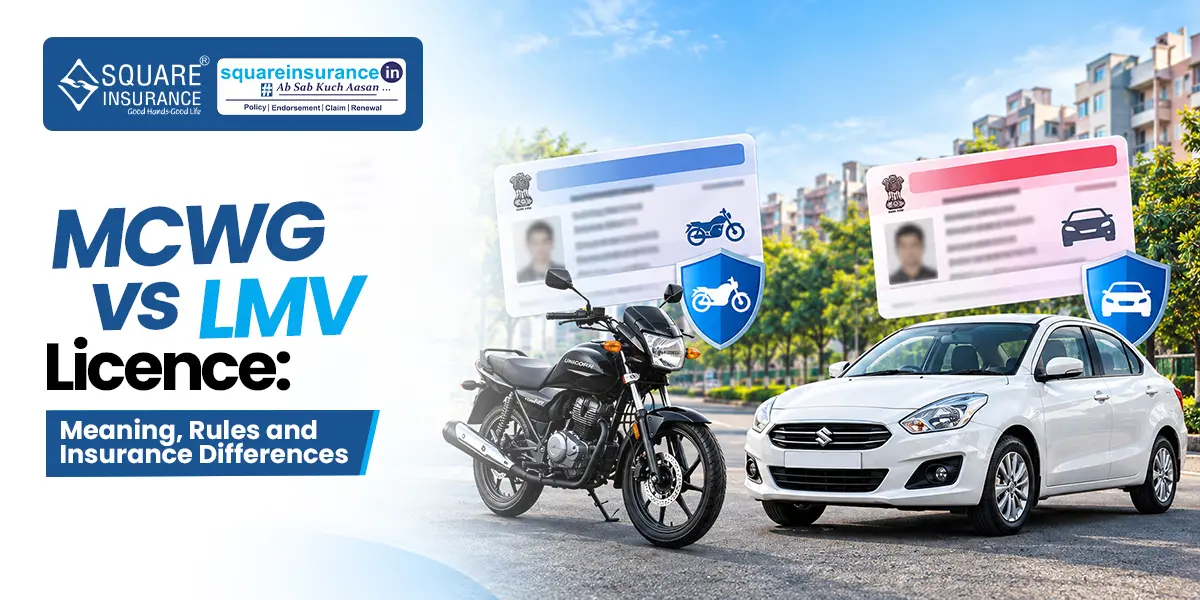
- MCWG stands for Motorcycle With Gear, while LMV stands for Light Motor Vehicle.
- A LMV Licence does not provide you with the right to operate any other type of vehicle
- You can apply to add another vehicle category to your driving licence by following the required process.
- Third-party insurance is mandatory for both motorcycles and cars used on public roads.
- A valid driving licence is important when making a motor insurance claim.
A driving licence allows you to drive a particular set of vehicles in India. MCWG and LMV are two common types of driving licences. LMV is a general category for two-wheeler vehicles that include private cars, while MCWG applies to motorized vehicles with gears.
The difference between the two categories is important because it determines which kind of vehicle one can operate on roads. It is also relevant from the perspective of motor insurance policies as well as making claims against them.
Let’s understand the MCWG licence meaning, LMV driving licence rules, and how your licence can affect an insurance claim.
What Is the MCWG Licence Meaning?
MCWG stands for Motorcycle With Gear. This licence category allows you to ride motorcycles with gears.
For example, geared commuter bikes and sports bikes generally fall under this category.
Here are a few things to know about an MCWG licence:
- You need to be at least 18 years old to apply.
- You must first obtain a learner’s licence.
- You need to pass the required driving test to get a permanent licence.
- Your licence must be valid when you ride on public roads.
An MCWG licence does not automatically allow you to drive a car. You need the correct licence category for that vehicle.
What Is an LMV Driving Licence?
LMV stands for Light Motor Vehicle. In general, this category includes private cars and other light vehicles that satisfy legal requirements.
For example, a hatchback, sedan, or SUV that is used as a private vehicle typically falls under the LMV category.
The following are a few of the most crucial restrictions and conditions:
- You must be at least 18 years old
- You must first get a learner’s licence before applying for a permanent one.
- You must pass a driving examination for the relevant category.
Additionally, commercial vehicles often require additional authorization or a different Licence category.
Note: A Light Motor Vehicle Licence does not provide the Licence holder with the right to operate any type of vehicle. Always double-check if your Licence entitles you to operate a specific vehicle.
Difference Between MCWG and LMV
The main difference between MCWG and LMV is the type of vehicle you can drive with each licence.
| Basis | MCWG Licence | LMV Licence |
|---|---|---|
| Full form | Motorcycle With Gear | Light Motor Vehicle |
| Vehicle type | Motorcycles with gears | Eligible light motor vehicles, including private cars |
| Examples | Geared commuter bikes and sports bikes | Hatchbacks, sedans and SUVs |
| Minimum age | Generally 18 years | Generally 18 years for a non-transport licence |
| Driving test | Test for the motorcycle category | Test for the relevant light motor vehicle category |
| Learner’s licence | Required | Required |
| Insurance | Valid motor insurance is required | Valid motor insurance is required |
If you own both a motorcycle and a car, you may need both categories on your driving licence. Having one category does not automatically give you permission to drive vehicles covered by the other.
Rules for MCWG and LMV Driving Licence
Under the Motor Vehicles Act, 1988, MCWG and LMV are separate licence categories. However, the basic rules for obtaining and renewing both licences are similar.
1 Eligibility by Age
To apply for an MCWG (Motorcycles with gear) or non-transport LMV licence, an applicant must be 18 years or older. The age criterion for other vehicle categories may vary.
2 Learner’s Licence Application
Drivers must apply for a Learner’s Licence from the Parivahan portal or the designated RTO (Regional Transport Office) counter for the desired vehicle category. They must also abide by the learning guidelines while operating a vehicle for practice.
3 Driving Test
A driving test must be passed for the particular vehicle category desired. However, a motorcycle test is not valid for a car licence and vice versa.
4 Driving Licence Category
Before driving a vehicle, it is essential to ensure that the driving licence covers the category of the vehicle to be driven. In case of intent to operate a vehicle that is not covered by the licence, an additional category must be added.
5 Licence Validity and Renewal
It is of utmost importance to keep track of the expiry date of a driving licence. A renewed licence must be acquired well before the expiry date in order to prevent legal and insurance complications.
Insurance Differences Between MCWG and LMV Vehicles
The main insurance difference between MCWG and LMV vehicles is the type of vehicle you want to insure. Motorcycles need two-wheeler insurance, while LMV need car insurance. Third-party insurance is compulsory for both when used on public roads in India.
| Insurance Factor | MCWG | LMV |
|---|---|---|
| Type of insurance | Two-wheeler insurance | Car insurance |
| Mandatory cover | Third-party insurance | Third-party insurance |
| Premium | Usually lower, depending on the bike | Usually higher, depending on the car |
| Own-damage cover | Pays for covered damage to the motorcycle | Pays for covered damage to the car |
| Add-ons | May include zero depreciation and roadside assistance | May include zero depreciation, engine protection and roadside assistance |
Conclusion
The difference between MCWG and LMV classifies the various driving licence categories that are available to citizens. MCWG classification applies to all geared motorcycles, whereas LMV classification applies to eligible light motor vehicles like private cars and other light vehicles.
The correct driving licence is critical because it helps determine the motor insurance premium. Having the wrong category on a driving licence or an expired licence may cause complications when dealing with motor insurance companies.
It is important to check and confirm the details on a driving licence and ensure that it is renewed before the expiry date to avoid inconveniences when dealing with any insurance company handling motor policies.
FAQs
No, the MCWG licence is only for motorcycles with gears. In general, you will need an LMV Licence to operate a private vehicle.
No, unless your licence mentions the category of the vehicle you intend to drive, you can't.
Yes, you can apply to add another category by following the procedure and fulfilling the necessary conditions.
An expired licence may have an impact on a claim, but it doesn't always come back. It is determined by the sort of claim, the terms of the policy, the laws that apply, and the nature of the incident.
Driving licence validity for insurance claims is important because your licence must be valid and cover the vehicle you drive. An expired licence or the wrong vehicle category may affect your claim, depending on the policy terms, applicable law,
 2094*
2094*By clicking on You, Agreed to our Privacy Policy & Terms of use *Disclaimer
- 5.5 CrRegistered Consumers
- 50+Insurance Partners
- 3.4 CrPolicies Sold


